Using the Three Horizons Framework to Explore Sustainability Transitions
Translated with the help of ChatGPT, original in Finnish in Linkedin Pulse here.
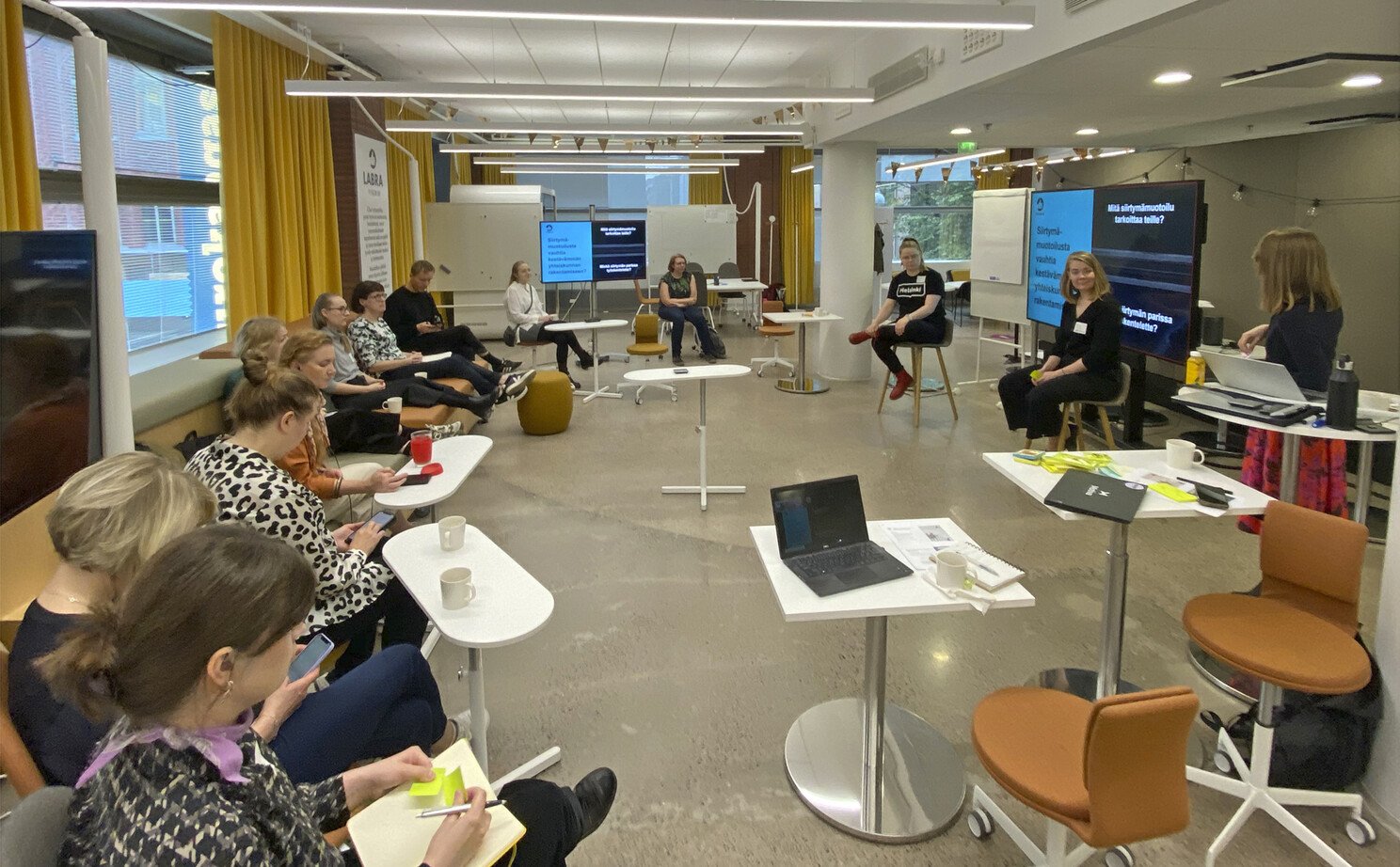
Designers for the environment organized a workshop focused on transition design for experts working in design and sustainability as part of the Work 2.0 Lab Sustainability Week in September 2023. Designers for the environment is a peer network for designers and design-oriented professionals working in the public sector. The network’s goal is to promote sustainable practices within the field of design and more broadly across society.
The workshop explored transition design through the Three Horizons Framework. Participants examined how the green transition could be accelerated in the areas of the circular economy, transportation, and the real estate and construction sectors. In this article, we reflect on how the framework worked in practice and what we learned from the workshop.
What Are Transition Design and the Three Horizons Framework?
Transition design is about expanding both the context and time horizon of design so that it encompasses broader social and environmental perspectives. Its purpose is to use design as a means of facilitating the transitions needed to create more sustainable futures [1].
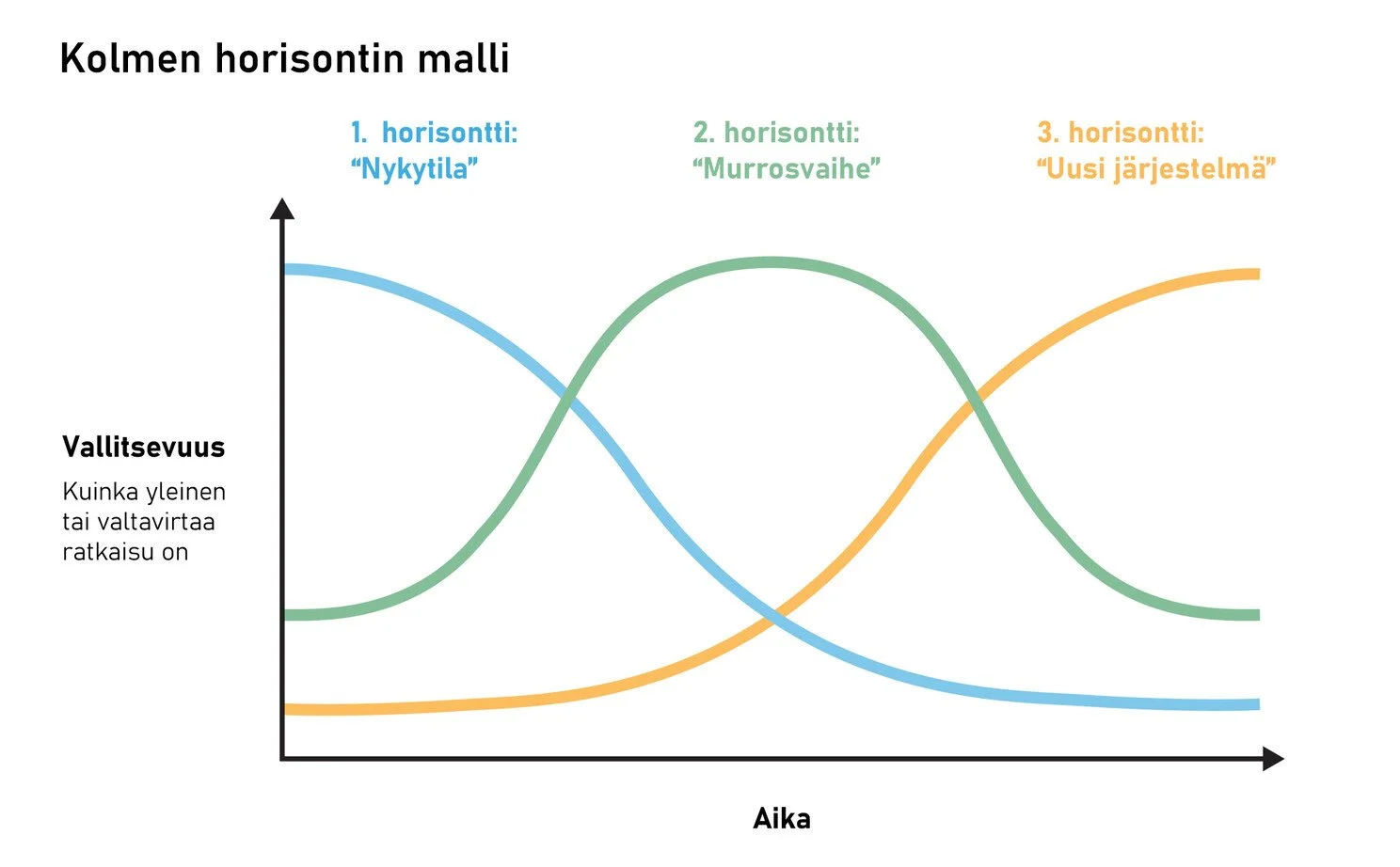
The Three Horizons Framework, in turn, is a foresight methodology used in futures studies. It provides a way to represent large-scale change over time and to identify solutions and trends that represent different “currents” of development. The framework can be applied to discussions about a wide variety of transformation processes. Each of the three horizons represents a different phase of change, and solutions associated with each phase can be identified in the present to varying degrees [3]. The timeframe covered by the framework depends on the topic being examined and may range from five years to several decades.
Horizon 1: Business as Usual
The first horizon represents the current state, or business as usual (BAU). It includes familiar solutions that no longer serve, or are no longer compatible with, the desired future or the changes required to achieve it.
For example, within the transportation system, private ownership of internal combustion engine vehicles could be considered a Horizon 1 solution. It remains a familiar and significant part of the current system, but it hinders the achievement of emissions reduction targets, and we know that it must largely be phased out.
Horizon 2: The Transition Phase
The second horizon represents a period of disruption and transition. It includes solutions, innovations, and experiments that help move society from a problematic present toward a desired future, although they may not themselves be permanent or fully sustainable solutions. Horizon 2 solutions draw from both the old and the new, containing elements of each.
In the transportation sector, privately owned electric vehicles could be seen as a Horizon 2 solution. While technologically different from conventional cars, they still largely operate according to the logic of Horizon 1 and the business-as-usual paradigm. As a result, they are likely to be more socially acceptable and easier to adopt than Horizon 3 solutions.
Horizon 3: The New System
The third horizon represents the emergence of a new system. It includes solutions whose characteristics align with long-term strategic goals and the needs of a changing world, such as the objectives of the Paris Climate Agreement. In this sense, Horizon 3 solutions are the most viable in the face of ongoing change.
Horizon 3, the new system, consists of solutions whose characteristics are compatible with future strategic objectives and the needs of a changing world.
Within the workshop, examples of Horizon 3 solutions in transportation included community-owned electric vehicles and mobility-as-a-service systems. These solutions continue to meet traditional mobility needs while aligning more closely with emissions reduction and efficiency goals. However, they require broader shifts in values and behavior. The discussion also extended further by challenging the underlying need for mobility itself. Examples included urban planning based on the “15-minute city” concept and increasing the role of walking and cycling as primary modes of transport.
How We Used the Three Horizons Framework in the Workshop
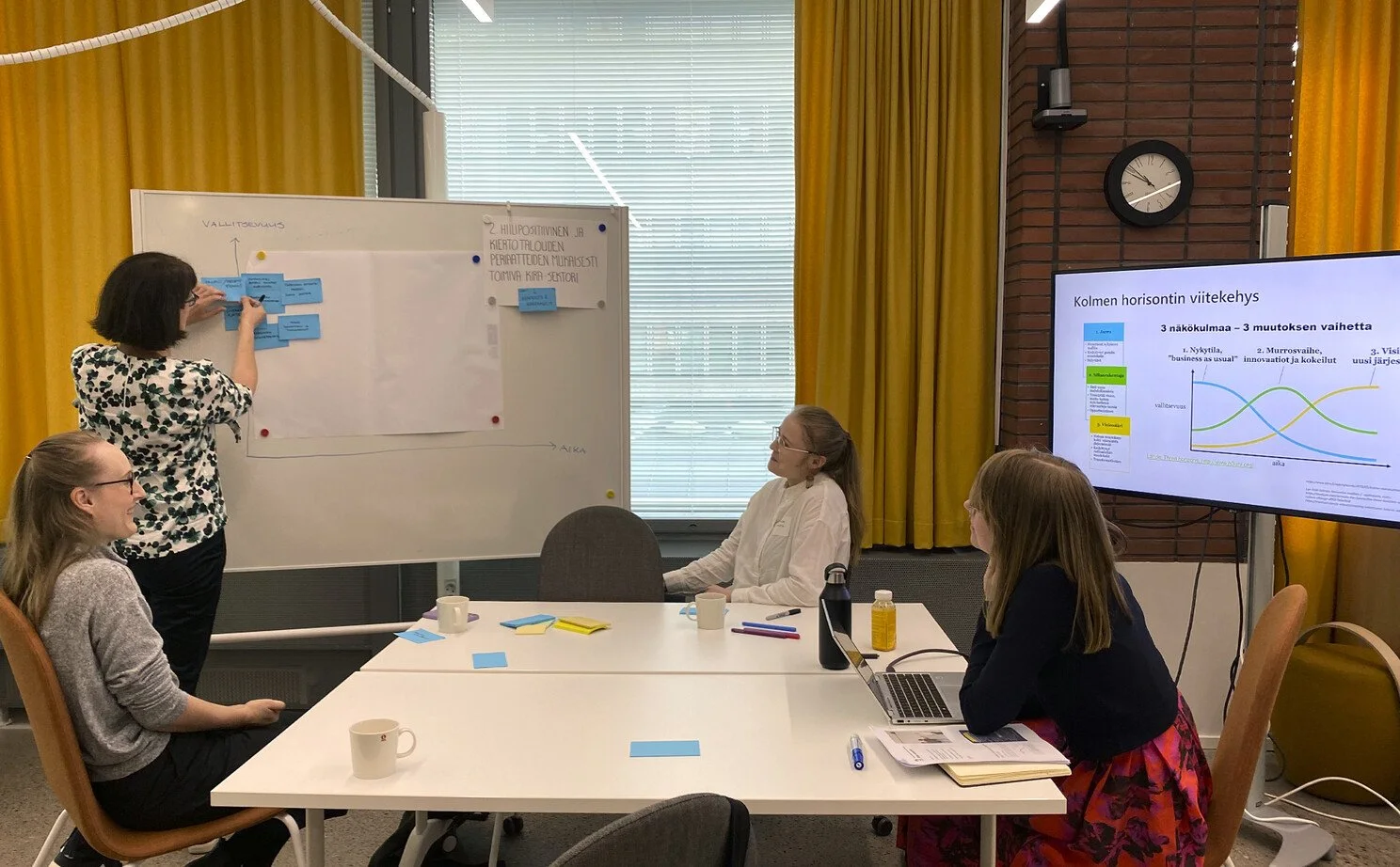
Following an introduction to the framework and a panel discussion, participants divided into three thematic groups based on their interests:
Finland as a leader in the circular economy
A carbon-positive real estate and construction sector operating according to circular economy principles
Transitioning to a transportation system that enables zero-emission mobility
Each group could further narrow its focus if desired. For example, the circular economy group chose to focus specifically on the clothing and fashion industry.
The workshop lasted 1.5 hours and was structured in three phases.
Phase 1: Mapping the Current State
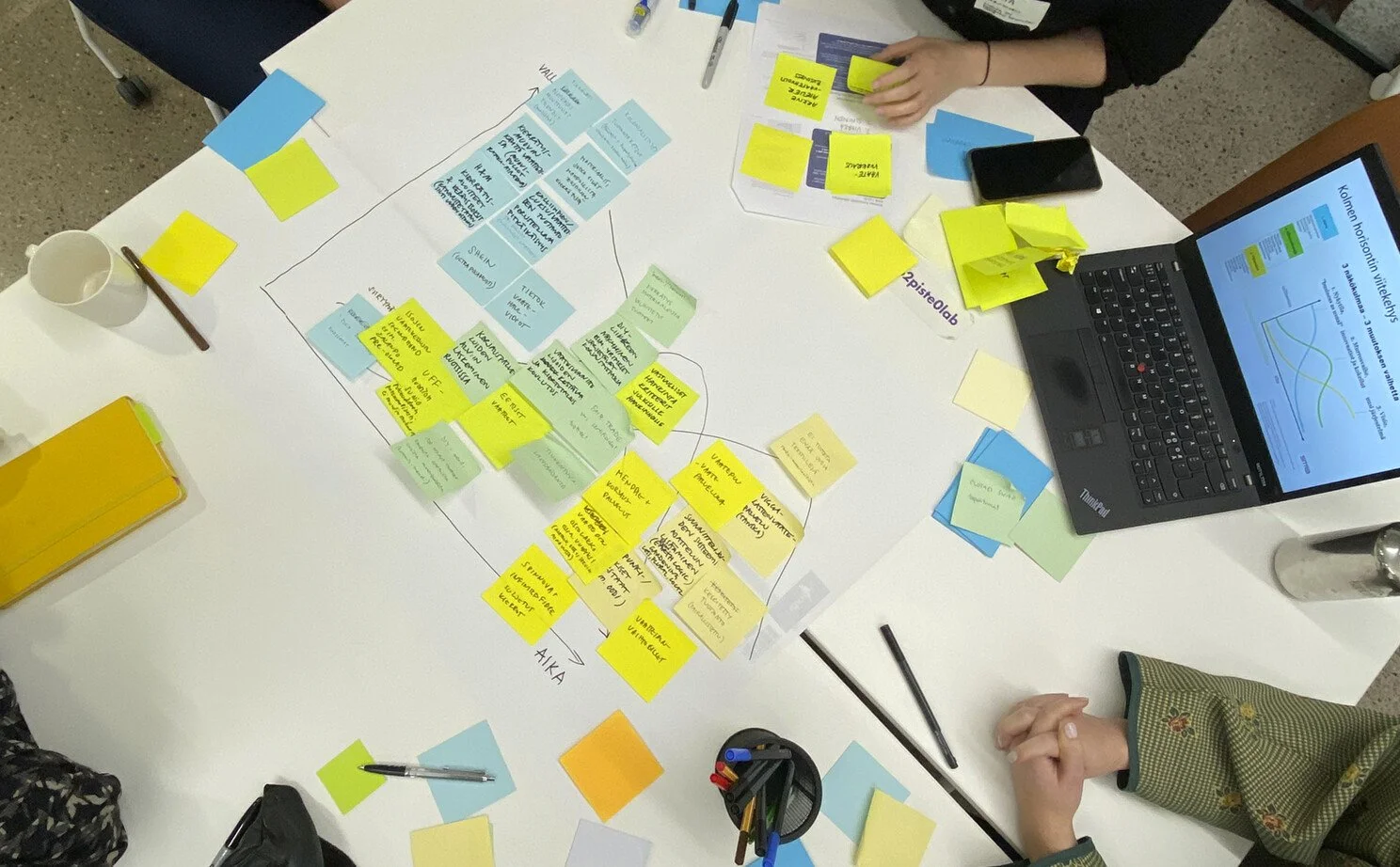
In the first phase, groups focused on Horizon 1, the current state. Participants discussed examples of business-as-usual practices related to their chosen themes. These examples were written on blue sticky notes and placed on a canvas according to how dominant they were perceived to be (vertical axis).
Dominance refers to how common or mainstream a particular solution is within the defined geographical area [2].
Phase 2: Exploring Horizons 2 and 3
In the second phase, participants examined Horizons 2 and 3 simultaneously. This approach was chosen because distinguishing between transitional solutions and genuinely transformative ones can sometimes be difficult. Defining the desired future state first can also help identify solutions that accelerate movement from the current state toward that vision.
Participants used green sticky notes to outline solutions representing a successful green transition in the future (Horizon 3). Yellow notes were used for innovations and solutions viewed as temporary enablers of the transition toward the new system (Horizon 2).
Participants also identified existing solutions and trends that already embody aspects of the future system today, often referred to as “pockets of the future” [3].
Phase 3: Examining Change Over Time
In the third and final phase, groups explored the temporal dimension of the framework in greater detail. Each group defined its own timeframe for the transition (horizontal axis).
In addition to considering the timeframe, participants discussed how the dominance of each horizon might change over time and explored alternative pathways through which different futures could emerge.
In the most common version of the framework, the horizons rise and fall smoothly over time. In reality, however, transitions rarely occur so neatly. The shift toward a new system may be delayed if transitional innovations are used primarily to prolong the dominance of the current system rather than facilitate sustainable transformation. Conversely, change may occur abruptly through collapse and necessity if society clings to the status quo for too long [3].
What Did We Learn?
Working with the Three Horizons Framework generated a range of interesting observations and ideas for improving both the methodology and its application. Below, we summarize the four most important insights identified by the organizing team.
1. The Framework Helps Identify a Wide Range of Solutions Required for the Green Transition
The framework supported discussions around complex issues by providing a concrete structure. Participants found it relatively easy to identify and categorize solutions, trends, and innovations into different horizons. Collective discussion around the examples revealed the diversity of possible solutions and highlighted bottlenecks that currently hinder the mainstreaming of the green transition.
2. The Framework Encourages Thinking Beyond the Present
A common challenge in discussions about the future is the tendency to focus only on solutions that seem realistic from today’s perspective. This can limit exploration even when the goal is to identify radically different alternatives that challenge prevailing systems.
The Three Horizons Framework encouraged more expansive thinking. Beyond discussing specific solutions, participants naturally explored deeper enablers of change, including shifts in values, mindsets, and cultural norms.
3. Tension Between Horizons 2 and 3 Sparks Valuable Debate About Sustainability
Participants naturally held different expectations and perspectives regarding Horizon 3 and the characteristics of a truly sustainable future.
Addressing Horizons 2 and 3 simultaneously helped facilitate discussion about which solutions genuinely represent transformative and sustainable futures (Horizon 3) and which are likely to be temporary transitional solutions that will eventually fade away (Horizon 2).
This productive tension focused discussions on the defining characteristics of desirable futures.
4. A Multi-Perspective Approach Helps Make Sense of Current Change Dynamics
We were surprised by how quickly discussions reached a deep and concrete level, despite the fact that most participants were unfamiliar with both one another and the framework.
The multidisciplinary group, representing a variety of sectors, enabled the themes to be examined from multiple perspectives.
Based on our experience, the Three Horizons Framework makes it possible to explore the drivers, barriers, and pain points of sustainability transitions within a specific sector in a comprehensive yet concise and accessible manner.
The workshop also provided an opportunity to exchange perspectives on the state of the green transition in Finland and to share examples of good practices from participants’ organizations, professional contexts, and everyday lives.
Feedback on the workshop was overwhelmingly positive, and many participants reported feeling inspired to organize similar workshops within their own organizations.
Conclusions and Recommendations
In conclusion, while the Three Horizons Framework inevitably simplifies highly complex issues, it remains a valuable tool for analyzing and structuring transition processes.
Applied within a workshop setting, the framework proved to be an excellent tool for examining the green transition and the solutions required to achieve it.
The Three Horizons Framework proved to be an excellent tool for exploring the green transition and the solutions it requires.
In our view, the framework is most effective in situations where participants wish to discuss collectively what should be promoted and what genuinely sustainable solutions might look like.
If you are planning a similar workshop, it is important to allocate sufficient time for discussion and to define the scope of the topic appropriately. In our workshop, the themes were intentionally broad because our primary objective was to test the framework itself. However, the less time available, the more carefully the topic should be focused and the more preparation should be undertaken to support discussion.
By identifying solutions within one’s own work and everyday life and considering which horizon they represent, it becomes possible to discover new ways of accelerating the green transition in the present.
We therefore encourage everyone to experiment with the Three Horizons Framework within their own field or organization, and we recommend that designers add it to their methodological toolkit.
Authors
From Designers for the environment: Riikka Manninen, Linda Vanni, and Emma Berg. Netta Korhonen also participated in organizing the workshop.
References
Irwin, T. (2015). Transition Design: A Proposal for a New Area of Design Practice, Study, and Research. Design and Culture, 7(2), 229–246. DOI: 10.1080/17547075.2015.1051829
Sitra. (2018). Three Perspectives on a Vision: Current State – Transition – Vision. Available at: https://www.sitra.fi/app/uploads/2018/05/kolme-nakokulmaa-visioon-harjoitus.pdf
H3Uni. (2023). Three Horizons. Available at: https://www.h3uni.org/tutorial/three-horizons/